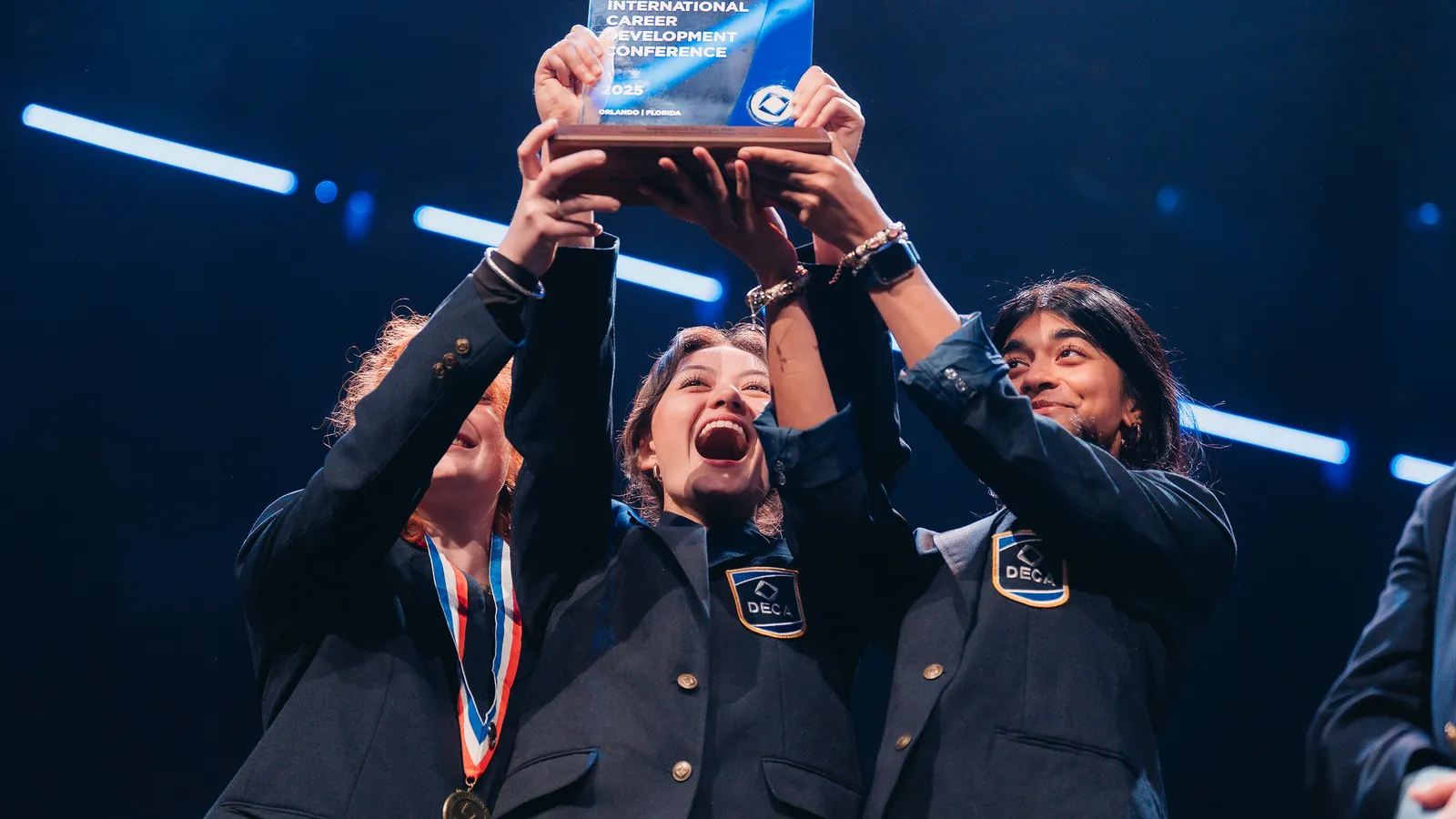
Think back on your last ceremony: the ceremony you worked tirelessly on to ensure would serve as the crowning jewel of your conference. Scores of students have been awarded for their participation and hard work over the year, and they deserve to be acknowledged in front of a packed room. But after about the fourth or fifth award category, something happens. The excitement fades. The applause loses its power. Everyone checks their phones. Your announcer sounds hoarse. Your students are still making their way to the stage. The clock keeps ticking and your ceremony is starting to feel like an eternity. In short, your ceremony process is broken.
The real issue here isn't the size of the event but the actual process of getting winners to the stage. Streamline that process, and you can recognize double the students without exhausting yourself and them.
The Bottleneck Is the Walk, Not the Award
Every ceremony wastes time somewhere, and that's okay. What makes a ceremony feel like a waste of time is wasting time in critical places. Almost all ceremonies fall prey to this particular issue: that long stretch of time between calling out a name and getting that individual in front of everyone else.
Fifteen seconds might not sound like a lot, but try multiplying that time by 300 people. The traditional approach is the worst offender. First, you announce a series of names. Next, you wait for those individuals to navigate through the crowd and find their way to the stage, while you continue to wait impatiently on an empty stage. After they make their appearance, you move on to announcing some bigger award—until those recipients appear. Rinse and repeat ad nauseum until you finally reach the end of your ceremony... or until your host venue decides to start charging you for overtime.
Your problem is the transition itself, and the fact that you can never get away from it. The solution is to eliminate any gap between winners at all: Never let your stage be empty!
Pre-Calling: Stage Winners Before You Need Them
Pre-calling is the idea of staging all of your winners in a staging area close to the stage prior to their moments of recognition. To visualize it, picture a flight terminal. Passengers don't start to jog from the parking lot to their flight gate the second their row is called. No—they've already been staged at the correct location and wait quietly until they're given access.
Similarly, you need to get all of your winners pre-called and staged near the stage so that they're ready to take their moment as soon as it comes.
Double-Calling: One Group Up, One Waiting
Double-calling is the baseline version of pre-calling, and for most ceremonies it's all you need.
The setup is simple:
- Group A is on stage, being recognized, applauded, and receiving their awards.
- Group B waits in the holding area, already stage and ready to go.
- once Group A exits the stage with their awards, Group B walks straight on.
While Group B has its moment, your staff pull Group C into the now-empty holding area. This cycle repeats until you've finished recognizing every event's winners. There's always one group being celebrated and one queued behind them. The stage never goes dark, the room never waits, and the applause stays loud because the pace keeps everyone leaning in.
For a single-stage ceremony with a few hundred winners, double-calling alone can cut your run time dramatically.
Triple-Calling: Keep the Stage Fed at High Volume
When you're moving very high volumes, even double-calling can develop a small lag. The instant a group leaves the holding area, that space sits empty until staff refill it. With big groups, that refill takes time you don't have.
Triple-calling fixes it by running two holding areas that alternate:
- Holding Area 1 feeds the current group to the stage.
- Holding Area 2 is already filling with the next group while Area 1 empties.
- When Area 1's group finishes, Area 2 walks on, and staff immediately reload Area 1.
You're never waiting on a single area to refill, because the other is always loading in parallel. Think of a relay team where the next runner is already in position before the baton arrives. It costs more staff and more floor space, so save it for your biggest ceremonies — but when you've got hundreds of team-event winners to move, it's the difference between a show and a slog.
The Math Has to Work
Here's the part that gets skipped, and it applies to double-calling and triple-calling. Pre-calling only saves time when the award flow stays simple.
It works beautifully in three cases:
- One award per group — a single trophy or plaque hands off fast.
- Everyone staged gets the identical award — no sorting, no decisions, just distribute and go.
- You award fewer people than you call up — stage the top 10, recognize 1st through 5th, and you've got margin built in.
But here's where it breaks. If the group you pre-called is set to receive a mix of different awards — varying medals, ribbons, or quantities that don't line up cleanly — the math stops working. Now you're sorting and distributing on stage in front of everyone. Pre-calling can actually take longer than just calling groups up one at a time.
So before you commit to a staging pattern, check the flow. Uniform awards or a recognized count smaller than the called count? You're in great shape. A messy mix of different awards per person? Rethink it.
Flash Names on Screen for Large Team Events
Now here's a technique that saves the most time of all, especially for team events where one award covers six or ten students.
Typically, an announcer will read every name on every team, out loud, for every award. With large events, that's hundreds of names. It's slow, it's brutal on your emcee's voice, and by the 400th name winners start blending together.
Try this instead. Flash the full winner list on screen and have staff direct those students to the holding area. Your announcer only reads the small group actually on stage at that moment, while the screen handles complete recognition.
That does three things at once:
- Maximizes throughput by cutting the slowest part of each award.
- Saves your announcer so the emcee stays sharp through the whole program.
- Keeps recognition complete — every name shows clearly for the room, the photos, and the livestream.
Students still get recognized, advisors and parents are still getting their photos, and the room stays energetic. You just stop burning minutes on lists everybody is already having a difficult time following along with.
The Field-Tested Details That Make It Run
Staging patterns get you most of the way. These four operational pieces are what keep a big ceremony from coming apart at the seams.
- Run a live script. Give stage managers and holding-area staff a live view of which events are on stage and how many winners to expect. That quick double-check before a group goes up kills the awkward pause where you're squinting to see if everyone made it. Tools like Shoflo and Script Elephant make this easy.
- Set placement markers. If an event calls the top 10 teams, drop 10 markers in the holding area. Stage each group on the markers and verification becomes instant — you can see at a glance whether anyone's missing.
- Add live TV monitors. Especially for triple-calling, put monitors in your holding areas that alternate between the event being staged and the one up next. Your floor team always knows what's coming, no shouting across the room.
- Wire up an intercom. Make sure holding-area staff can talk to backstage and production row. When everyone confirms award placement, show flow, and status in real time, the whole operation stays on the same page.
Key Takeaways
- Transitions drive your run time, not your award count — never let the stage go empty.
- Double-calling is your default; step up to triple-calling only when volume creates a refill lag.
- The math must work for both patterns — uniform awards or fewer recognized than called.
- Watch for mixed awards per person, which force on-stage sorting and slow the line.
- Flash names on screen for large team events to protect throughput and your announcer.
- Back it with operations — live scripts, placement markers, monitors, and comms.
Build the Ceremony Your Students Earned
Speeding things up doesn't mean cutting corners on recognition. It's the opposite. Every technique here removes the dead time that drains your ceremony, so the energy holds and every winner gets their moment in front of a room that's actually watching.
Recognize more students. Keep your announcer fresh. Finish on time. Give your audience a show worth staying for.
Start with one decision for your next grand ceremony: where will your holding areas live, and who will run them? Get the staging right, and the rest falls into place.
If you're already rethinking the operational side of your conference, our guide on designing CTSO conferences for maximum efficiency covers the scheduling and logistics that surround a ceremony like this.