Now that we have learned about speed and ease of customization offered by CTSO Central, let's talk about how this platform solves two challenges associated with older systems – permissions and reports.
Proper permissions in software might be difficult to achieve. For example, organizations such as DECA, FBLA, HOSA, or TSA have a clear hierarchical structure where they consist of national organization, state association, chapter, and member. Data permissions and reports should be set up according to this hierarchy. However, in older software, things were simplified to a certain extent, which led to a bunch of workarounds, thus making the process complex and error-prone.
Permissions That Align with Your Organization
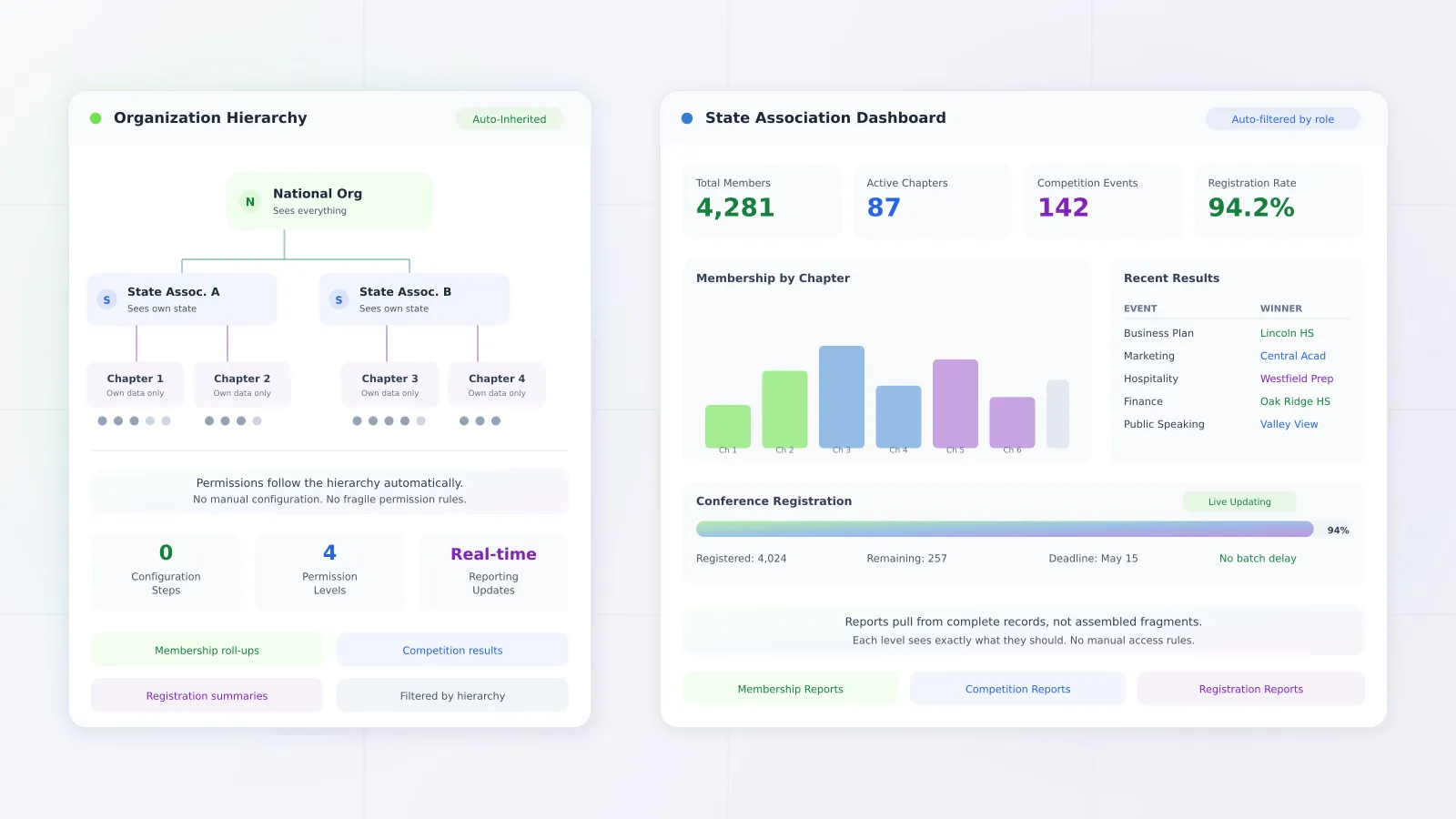
Organizations such as DECA, FBLA, HOSA, or TSA have a clear hierarchical structure, where their members belong to National Organization, State Association, Chapter, and themselves (member).
CTSO Central got it all figured out from the very beginning. Once a user creates a chapter in association, the system knows what national organization it belongs to. Adding a member to a chapter doesn't require any further actions related to associations or national bodies because everything happens according to organization's structure automatically.
The system functions well because this structure is inherent to the data itself, not added later with complex rules. When a chapter understands its parent association and national organization, the system doesn’t need to work hard to remember who belongs where.
Easy Reporting
When your data is structured in such a way that permission management is consistent with the structure, report generation becomes easy. Old-fashioned systems find it difficult since the required data is spread out everywhere, and it takes time to collect all this information while ensuring that only those with access rights see it.
With CTSO Central, however, things become easier. The related data will be found in one place; hence, there will be no need to piece data together when preparing reports. Access rights are automatically aligned with the organization, and therefore, a state director will be able to access information about members in their jurisdiction without doing anything else.
This consistency is seen in the entire system:
- Membership reports will follow the hierarchy from chapters to associations and then national level, with each party getting information that affects them alone.
- Results of competitions will be available immediately following the scoring of the competition.
- Registering members will be updated immediately during conference registration.
The Complete Picture
Throughout this series, we’ve highlighted how CTSO Central’s data setup improves speed, customization, and automatic permissions:
| What It Does | How It Works |
|---|
| Fast and reliable | Related data loads all at once |
| Custom fields | New fields and formats fit in easily |
| Easy Exam Settings | Adjust over 30 settings on one record |
| Matches Org Structure | Permissions reflect the actual structure |
| Simple Reporting | Complete records, no piecing together, filtered by structure |
This isn’t just a random collection of features. It’s built on one fundamental decision: to store data in a way that reflects true relationships. This makes everything built on top of it better, faster, and easier to use.
CTSO Central is specifically designed for student groups, not just a repurposed platform for general events. When new features are introduced, they integrate seamlessly with your existing data. There’s no need for complicated updates or scheduled downtimes. You won’t hear phrases like “we’ll address your feature next quarter.” It simply works!