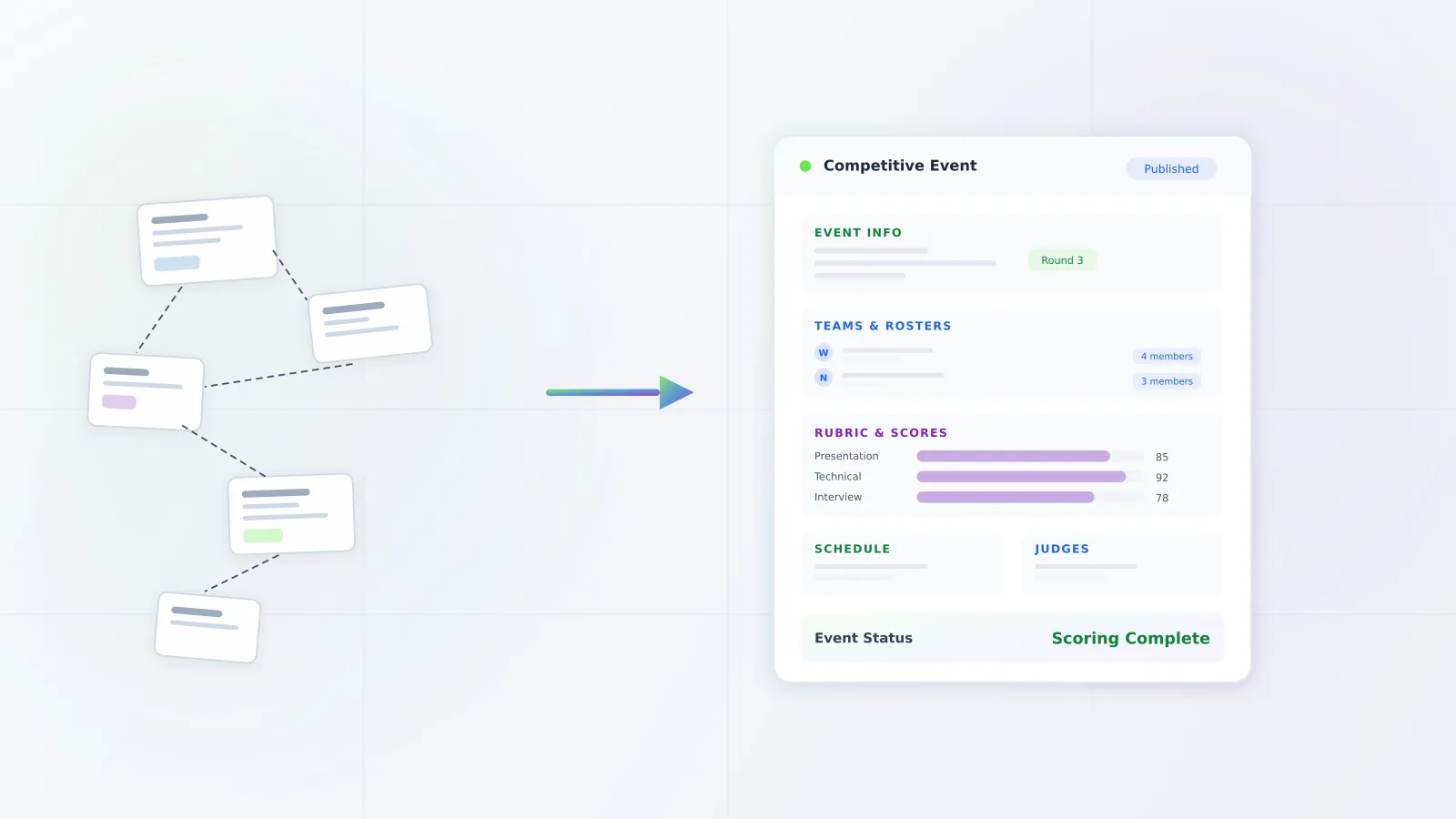
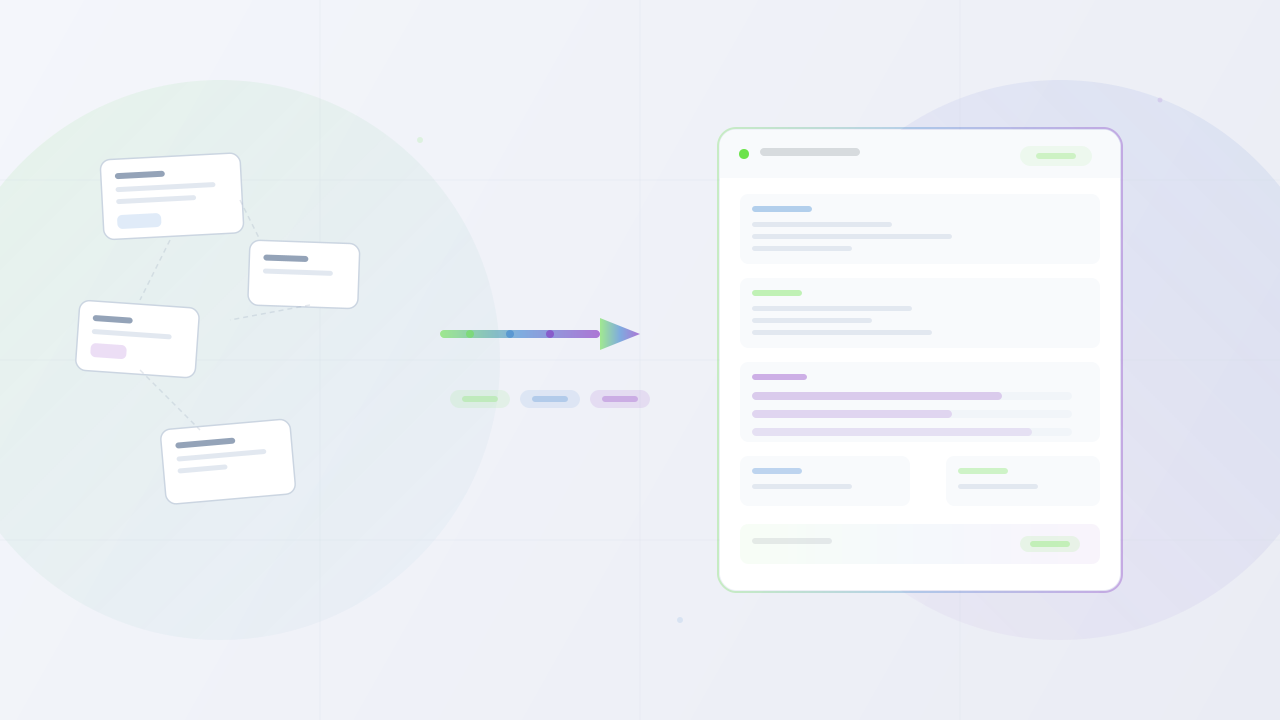
What does competitive event processing actually look like? For a CTSO's competitive events program, it's: competitive event, event entries, judges, rubric, competitor schedules, competitor scores, and results. But these are all interconnected- and for good reason.
Legacy platforms do not approach event processing this way. These platforms use antiquated technology that separate the different pieces of an event. The technology separates them like a car being broken down and stored as individual parts throughout a warehouse. The parts, or elements, cannot be viewed together without locating them individually and reassembling them. Imagine having to retrieve each piece of the car each time that you wanted to view the entire vehicle. This results in extremely slow and unreliable processes.
We know the analogy of a car, but let's consider a more massive project such as managing a state or international conference. We're not dealing with just one competitive event but many (hundreds), tens of thousands of students, dozens of chapters, rubrics, schedules, exams, configurations, etc., all interwoven together. On legacy platforms, every time that a page is loaded, there are many requests that are processed to retrieve each bit of data and reassemble it, acting as a technology treasure hunt.
CTSO Central takes a completely different approach. We store each event, conference, and member record as an individual object, meaning that each piece of data is complete and contained. Everything is kept together; there is no need for reassembly. This is all possible with the power of our high-performance, cloud-native database engine.
With this one decision alone, it changes the way the platform feels from a user's perspective, the speed at which we can push updates and additions, and the extensibility of the system.
Speed when the pressure is on
Deadlines and competition days can crash any platform. Advisor registration is coming in on thousands of advisors' computers at the same time, judges are keying in scores on many devices at the same time, and students are trying to quickly learn if they've made the final round of competition. Slow load times will lead to more frustrated clicking from team members and less time spent helping students.
CTSO Central keeps together what belongs together and data loads quickly. Entries to an event including a full roster is only one command and not a set of commands sent throughout the entire system. Registration has a quick, responsive upload time even during the simultaneous flood.
Search that covers everything
CTSO Central has a universal search bar that spans members, chapters, associations, exams, events, and more. Results are ranked by relevance, names show up before email addresses, and chapter names rank above chapter numbers. Search is fast and the results actually make sense.
| What you need | CTSO Central | Legacy platforms |
|---|
| Fast page loads | Related data loads together | Data scattered, reassembled per request |
| Platform updates | Ship without downtime | May require maintenance windows |
| Universal search | Built in, weighted, real-time | Bolted on, often stale or limited |
| Peak traffic | Stays responsive under load | Slows down when it matters most |
This is the foundation that everything else in CTSO Central is built on. In our next article, we'll look at how this architecture makes it possible to customize the platform for each organization's unique needs, without waiting on development cycles.